Wednesday, June 6, 2012

The Transit from Winona, Minnesota

.....I was a bit jealous of a friend of mine who lives in Japan, and who would therefore have the Sun above the horizon for the entire time that Venus was transiting the Sun, only to find out that he barely got to see any of it, due to clouds.  We were much luckier in Minnesota.  The sky was clear for all of the transit, from the first kiss of Venus on the Sun until sunset, about three and a half hours later.

And there were ducklings.  Ducklings are cool.
.....My setup point was on the eastern side of Lake Winona, where we had an excellent view of the western horizon.  I didn't really advertise this fact with any real lead time, so this location let me attract interest from really quite a lot of people walking around the vicinity.  (I must specifically thank Tony Thelen, who had come to see the transit and did a lot to invite/collect/waylay passers-by to take a look.)


Trying to center the Sun
.....Solar observing adds complications, because if you do the wrong thing, you do nigh-instantaneous long-term damage to your eye.  There were two safe observing methods that I used for this event.  On the front of the telescope, I have a solar filter that blocks out the vast majority of the light, especially ultraviolet light.  Since I don't have a solar filter for my finderscope, and I seriously doubt that one exists, I try to get the Sun in view by making the shadow of the telescope as small as possible.  Even then, I usually need to take a few seconds "wandering around" in the sky.  

.....The Sun against the sky in not really a very large target, it only covers an area of the sky about one-half of one degree.  You could fit 360 Suns, side-to-side, across the sky from horizon to horizon.  Hold out at dime at arm's length, and you will easily cover the Sun.  In a telescope with a solar filter, the Sun appears as a bright yellow disk of light, and nothing else is even bright enough to show up.


And hanging out with the ducklings


.....I had done this part many, many times before, so all that was left was waiting for Venus to appear at the edge of the Sun.


.....Venus is closer to the Sun than the Earth; this is why Venus can be seen passing in front of the Sun.  It also means that we never see all of Venus against the sky.  When Venus is visible in the morning or evening sky, it is brighter than anything besides the Sun and the Moon, but seen through a telescope, Venus shows phases like the Moon.  Half of Venus is always lit, half of Venus always faces the Earth, but these can't be the same halves while Venus is visible, as shown below.


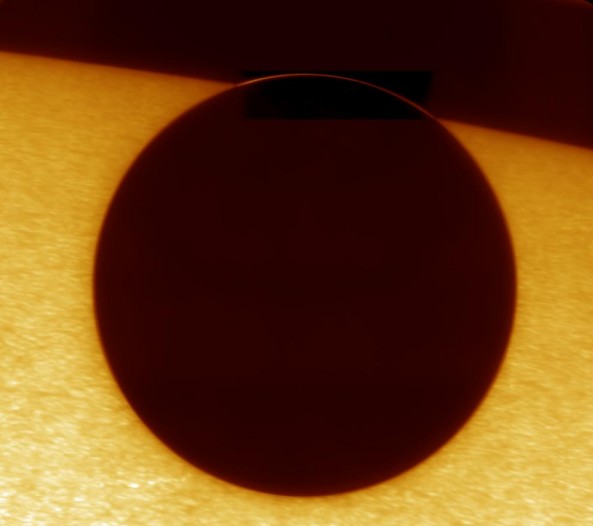
.....In fact, the only time we can see the full disk of Venus is when we cannot see Venus at all, when Venus transits the Sun.  What we see is the silhouette of Venus blocking the light of the Sun.  The dark marks on the Sun that are not the shadow of the planet Venus are sunspots, places where the Sun's magnetic field has been gnarled such that the magnetic field lines spring out from the surface, trapping gas at these kinks.  This gas isn't able to get replaced by new hot gas bubbling up from below, so it cools to a mere 7500 Fahrenheit, as opposed to the 10,000 Fahrenheit of the rest of the Sun's surface and appears dark against the much hotter surface.


.....When looking at something in a telescope, the image moves across the field of view due to the rotation of the Earth.  (Or, as it appears against the sky, celestial objects rising and setting.)  In this case, watching Venus move across the Sun is actually watching Venus moving in its orbit.  You can watch real change happening!  I think that this is one of the appeals in this type of astronomy.  The idea of the ancients that the heavens were eternal and changeless is still a pretty good day-to-day guide.  The Sun Moon, and planets make patterns, but something like this (that happened last in 1882, and then 2004, and the next one will be in 2117) lets us in to get a opportunity to mark one moment as separate and unique, to share with everyone else watching just at that moment.
 

.....Many ephemeral astronomical events are actually dependent on where you happen to be standing.  If you see a meteor, you share that with everyone else in a hundred miles or so, as that is small matter heating up in the Earth's atmosphere.  In a solar eclipse, such as the annular eclipse two weeks back (not well set up for most of the continental United States) the path of the eclipse is moving across the surface of the Earth, so where you are matters.  For this case, everything was happening 30 million miles away, so if you got to see it, you shared that moment with every other person on Earth watching at that time.

Speaking of these events ...

 .....The next solar eclipse will be on November 13th, but unless I have an audience in northernmost Queensland, you won't get to see totality. Northern Australia also gets an annular eclipse on May 9th.  North America gets a really good solar eclipse on August 21st, 2017, but I have plenty of time to write about that.  The next lunar eclipse for North America will be on April 15th, 2014. 


.....Happily, (with special thanks to my wife, and to Anthony Thelen, who are apparently much more accessible to people than I am when say "Hey, come look at the Sun!") a good time was had by all.


Photos by author (Sun, sunset), and Anne Marie Leckenby everything else.


Monday, June 4, 2012

The Transit of Venus Tomorrow!

.....Tomorrow is the Transit of Venus across the Sun!  (The last one for more than a hundred years.)  In the past, transits were very important, used to measure the size of the solar system, carefully noting how our location on Earth changed how we saw the eclipse.  In many senses, this is not going to make a huge differences to observers of this transit.  For example, the starting times of this transit (for observers in the continental United States) will see:

..................Venus begins to move in front of the Sun................Venus is entirely in front of Sun
Winona, MN...........5:04:31...............................................................5:22:00...(CDT)
Chattanooga, TN...6:04:27...............................................................6:21:58...(EDT)
Denver, CO............4:05:22...............................................................4:22:50...(MDT)
Seattle, WA............3:06:01...............................................................3:23:07...(PDT)

.....The times involved were obtained from this website.  The astute reader (you) will notice that except for the time zone shifts, the times are really not that different.

.....For North America (barring Alaska, the Yukon, the Northwest Territories and some of Canada's islands), the transit of Venus will be ongoing when the Sun sets, so these times will be the beginning of the event, with sunset as the end.

.....If you will be in the Winona area, there will be a telescope with a solar filter (for safe viewing of the transit) at the east end of the park around Lake Winona.  This will be set up near the John L. Schneider Police Shelter near the parking area across from the hospital.  I will be set up from 5 PM until the Sun is no longer visible.  If you are around, I hope to see you there - if you are not, good look observing the Transit.  (After this, I will discuss my next big project.)

Tuesday, May 29, 2012

One Week Left!

.....There is just one week left until the transit of Venus across the Sun.  I will very shortly have more specific information for a variety of places across the world, but if you wish to order special equipment for viewing the transit, you should probably do that as quickly as possible!

Saturday, May 19, 2012

A Partial Eclipse of the Sun Sunday (Safely Observing the Sun)

.....On the afternoon of Sunday, May 20th (which would, I think, be Monday, May 21st in Japan), there will be an annular eclipse of the Sun.  I have not brought this up before because for most of the United States, the Sun will be very low in the sky, if not set.  The Western US might have a shot at it -- Denver will set the eclipse start with the Sun a whopping 15 degrees above the horizon -- and much of Japan will get to see the eclipse at its best.  In any event, I'll mention this here because it is good practice for looking at the Sun, practice that will come in handy at the Transit of Venus next month.

Timing on the Eclipse:
.....For the eastern US, the eclipse will start with the Sun set, or very close to the horizon.  .....From southeast Minnesota, the eclipse starts a mere eight degrees above the horizon at 7:36 PM, and progresses through sunset.
.....From Denver, Colorado, the eclipse starts at 6:41 Pm, and peaks at about 7:20 when the Sun is close (about 8 degrees above the horizon) to setting.  But hey!  It counts as an annular eclipse!  (If you recall all of the big fuss about the "SuperMoon" last month, when the full moon came about when the Moon was at the closest point in its orbit, now, this new moon, is when the Moon is about as far away as it gets, and therefore smaller against the sky, and therefore it cannot fully block out the Sun.
.....If you live in Japan, this will be an annular eclipse peaking around 8:30 in the morning.  You're set.


How To Look At The Sun:


....Most times, the information that you get is simply "Don't look directly at the Sun!" (or, the slightly longer "Don't look directly at the Sun, moron!".  If one does give advice, if the advice is imperfect, or misunderstood, then the people come to you for an explanation.  Well, I'm going to be precise and also tell you at the beginning that if you are going to blame the internet for bad things that happened to you, you are probably already in contact with half a dozen Nigerian Princes, and have enough problems.


Shiny
.....The danger in looking at the Sun is not in the "shiny", but in the type of shiny.  We can treat light as lots of little tiny particles of energy.  Each type of light has a different level of energy; particles ("photons") of red light have less energy per particle than particles of blue light.  The bluer the light, the more energy each particle/photon has, and light that is off the visible charts on the blue end (ultraviolet light, then X-rays, then gamma rays) has more and more energy per photon as you move off the blue end.  The types of light that a glowing object gives off depends on the temperature.  While a hot object gives off all types of light, the hotter the objects the more high-energy photons are part of that deal.  These higher energy photons are dangerous because any given atom or molecule in your body can only interact with *one* of these photons at a time, and the higher the energy of that one, singular, photon, then more likely that might smash up some part of cell doing really important things -- like in your eye, processing light.  A tremendous number of red photons is far less frightening than one UV photon.


.....The Sun is hot.  Really freaking hot.  Even with that, the dangerous (UV) light isn't coming from that part of the Sun.


Not shiny
.....Surrounding the Sun is an atmosphere of much thinner gases.  For reasons that still aren't completely understood, but probably have to do with the Sun's powerful magnetic field, the thin gas above the Sun is at a much, much higher temperature than the surface, so it is this thin gas giving off most of the UV light.  This part of the Sun does give off nearly as much light compared to the surface of the Sun, so the brightness of the Sun causes your eye's iris to shrink down, therefore being smarter than you apparently are -- but much less so during an eclipse.


not pictured: angels
.....Now on to how to not destroy your eyes just to see something cool.  (Although, to be fair, really, REALLY cool.)  You can find plenty of web broadcasts showing the eclipse, transit, whatever, but I'm going to assume that your are at least at little like me, since I'm the only person here while I'm writing this, and assume that part of the appeal is seeing the actual light coming from the Sun at the time that it is happening.  The first, and one of the safest ways of watching an eclipse/transit is by using a pinhole camera.  Take a pin, and punch a hole in a piece of cardboard/stiff paper, and then position another piece of paper beyond the hole.


.....The hole will cause an image of the Sun to appear on the other paper.  This is totally safe, and it will show the progress of an eclipse/transit very well, but details like sunspots will be hard to see.


 .....Shown below is an image of Sun as projected.
Can you see these on the left?


 .....Another thing that can be done is too use binoculars in much the same way.  You may need to use sunglasses due to the brightness of the image, but this is entirely safe to look at.


.....Speaking of sunglasses, do not simply toss on sunglasses and look at the Sun!!! (See: three exclamation points.  On the internet, this means that this is true.)  There do exist products that are safe for looking at the Sun, but they absolutely, positively have to be specifically made for looking at the Sun, and they have to stand behind this.  Simply using dark glass tricks your eye into opening the iris as widely as possible, but it does not protect you against ultraviolet light.  Pictured are some glasses that I found useful; I include them as an example without any particular endorsement.  they have worked well for me, although I get no money if they sell any.  (Although, hey guys, this space for rent!) 


.....I recommend using headwear to protect yourself from the Sun.  Choose something that typically does not get the bright sunlight of success to keep heat off of you.  I'm going with a Brewers cap here for that purpose.  Good luck!  Over the next three weeks, I'll have more and more about the transit.


(All photos not hyperlinked to public domain images are taken by the author, with the last image taken by Anne Marie Leckenby.)

Wednesday, May 16, 2012

Transits Past, A Cool Look

.....While I will soon post on how to look safely at the Sun (A tricky proposition, not to be undertaken flippantly), I ran across this excellent historical piece on the transit of 1769, and the scientific value we have gained from observing transits.

.....James Cook and the Transit of Venus

Thursday, May 10, 2012

Venus On The Move


"Venus in the west was as bright as a street lamp, as bright as life, as bright as Miss Huntress' eyes, as bright as a bottle of Scotch"*

.....For months, now, Venus has been bright in the western sky.  As I write this, I am looking out of our living room window at Venus, shining brightly in the west.  (For the next couple of days, Venus will be near the star El Nath, in Taurus, the tip of the southern horn of the bull and very close to the Crab Nebula.)  Venus is now getting less and less prominent in the evening, getting closer and closer to the western horizon as Venus races to pass us on our orbit.  Most times, that would be that for seeing Venus, until Venus appears in the morning sky in late June.  This time, as Venus passes by us, it will be visible as a shadow across the Sun.

.....It would seem like this should happen more often; if you ask a small child to draw the solar system (I would do this all the time, so I assume that all kids do this), the final result of nearly circles in a flat page would be very close to how the solar system is - but not quite.  The flat sheet of paper is close, as the planets orbit in very close to the same plane.  the orbit of Venus, for example, is at an angle of 3.39 degrees to the plane of the Earth's orbit.  Now, if I said that I would fling a baseball not at the center of your face, but at an angle of 3.39 degrees above the center, you would probably not be very happy.**  However, at the distance of Venus at its closest, Venus makes a dot of only 0.008 degrees across against the sky, so the chance of this dot overlapping the half-degree dot of the Sun is very infrequent.  The last time, before 2004, was 1882.  The next time will be in December of 2117.

File:Venustransit 2004-06-08 07-49.jpg.....In the late afternoon of June 5th (next month!) we will get to see this.  The continental US will see Venus still transiting the Sun as it sets.  Japan would be an excellent place to view the transit from, with Wake Island being perhaps the best of all.  (Geez, this would have been a good time to go back to Guam.)  As this month progresses, I will have a number of posts on how to watch this, but I wanted to start now.


See Explanation.  Clicking on the picture will download
 the highest resolution version available. .....Still, while I was trying to find a public domain image of Venus to use, I came across this image, where sunlight can be seen shining through Venus' atmosphere.  Cool.

.....My next post will be about how to view the transit safely.  One could buy special film glasses to view the eclipse, but be absolutely sure that the film is not just "dark", but is specifically made to protect against ultraviolet light.  My next post will talk about why this is a danger, but just for the love of anything you like actually looking at, never stare directly at the Sun unless you abso-fraggin'-lutely know what you're doing.

* Raymond Chandler ***, Trouble Is My Business

** Don't worry; this is just an example.  There is a fairly limited number of people that I would like to smash in face the face with baseball, so I use this for a purely illustrative purposes.  Still, if you're not sure, ask.

**duh

Monday, December 5, 2011

Why "What is Up" has been down ...

.....I have not had a post go up since September for a couple of reasons that I wanted to share with you (though this is an aberration - the whole point of this blog is the sky, not me).  At the end of September, I had a bicycle accident that resulted in a hairline fracture of the S4 vertebra, which led to a couple of weeks of intense pain, which was much worse at night.  At the same time, my work situation became extremely negative, a full-fledged cautionary tale about the total lack of protection the worker has without a union.


.....In any event, the continuing evolution of a look for the monthly star map is coming very soon, and I will also begin looking toward the transit of Venus across the face of the Sun on June 5th, 2012.  It will be possible to actually watch the disk of the planet Venus cross the Sun.  This is definitely something to try to see, since we won't be able to see this happen again until December of 2117!